If you work online and move from country to country, one tax question eventually becomes unavoidable:
Where am I actually a tax resident?
For digital nomads, tax residency can be confusing. You may spend a few months in one country, work from another, keep a home in your original country, and have clients somewhere else.
That does not automatically mean you owe tax nowhere. In most cases, your digital nomad tax residency is determined by the tax laws of the countries connected to you not simply by where your laptop happens to be on a particular day.
Understanding your tax residency is the first step before calculating how much digital nomad tax you may owe.
What Is Digital Nomad Tax Residency?
Tax residency is the legal status that determines which country’s tax system considers you a resident.
For many countries, becoming a tax resident can mean reporting income earned both inside and outside that country, although the exact rules and treatment of foreign income vary.
There is no single international rule that tells every digital nomad where they are tax resident. Each country applies its own residency tests.
That is why two countries can potentially consider the same person a tax resident at the same time.
For a digital nomad, the important question is therefore not simply:
“Where did I work this month?”
It is:
“Which country or countries consider me tax resident under their rules?”
The 183-Day Rule Is Only Part of the Answer
The 183-day rule is probably the best-known test for digital nomads.
Many countries use physical presence as one factor in determining tax residency. If you spend around 183 days in a country during the relevant period, you may trigger tax residency there.
But 183 days is not a universal global tax rule.
Countries can use different periods and additional tests. Some look at a calendar year, some use a tax year or rolling period, and some consider factors beyond the number of days you spend there.
This means staying under 183 days does not automatically make you a non-resident.
A digital nomad could spend only part of a year in a country and still have a residency issue because of other connections.
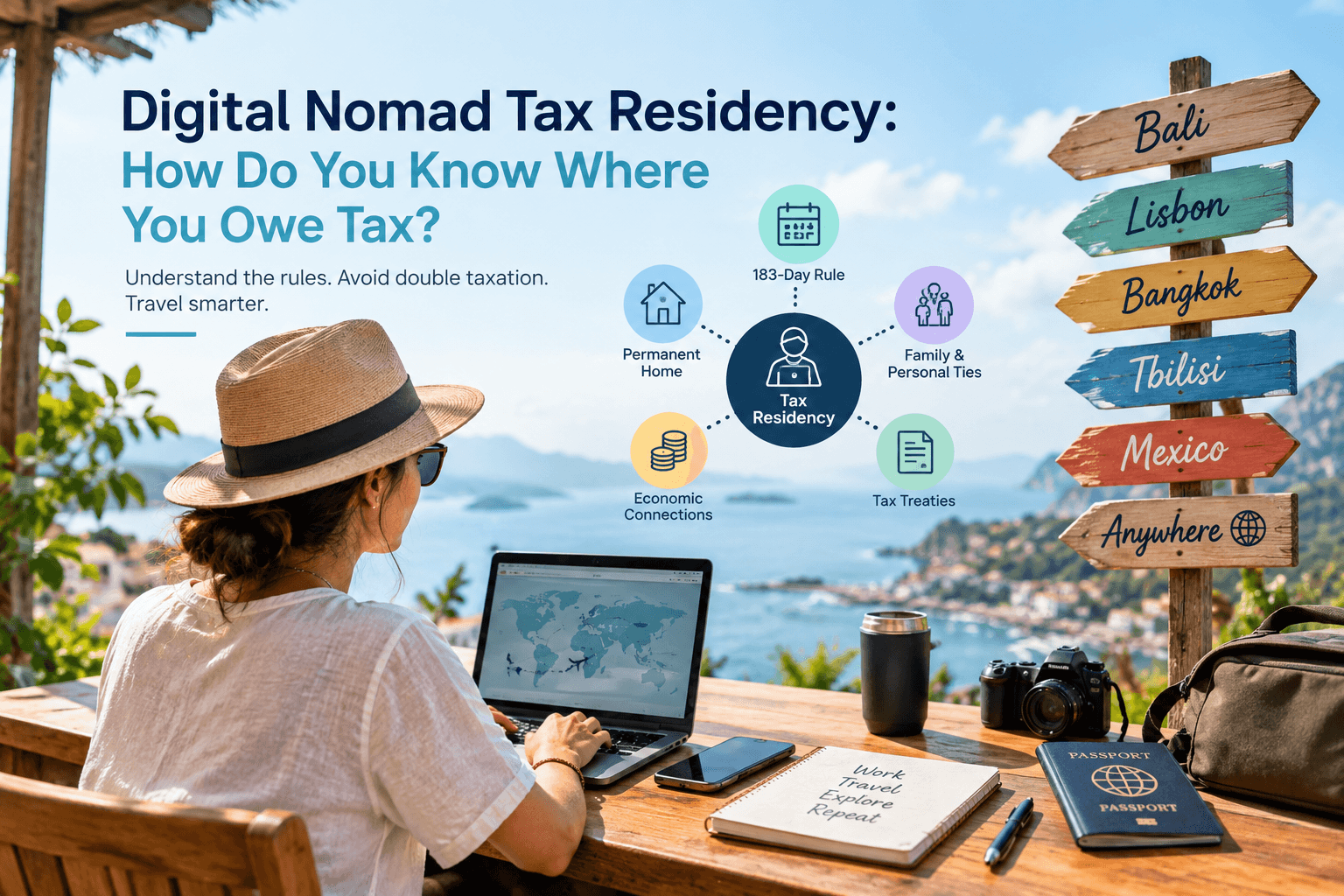
What Other Factors Can Make You a Tax Resident?
Countries can use several tests to establish tax residency.
Common factors include:
1. Physical presence
How many days did you actually spend in the country?
This is often the easiest factor to track, but it is not always the only one.
2. Permanent home
Do you have a home that is permanently available to you?
A country may consider the availability of a home when determining your residential status.
3. Family and personal ties
Where do your spouse, partner, children, or other close family members live?
Strong personal connections can be relevant to residency in some jurisdictions.
4. Economic connections
Where are your main business activities, investments, employment, or other economic interests?
These connections can help determine where your center of life or economic interests is located.
5. Your previous tax residence
Leaving your home country does not necessarily mean you immediately stop being its tax resident.
Some countries have specific rules for people leaving the country, meaning you may need to establish that you have actually ended your previous tax residency.
This is one reason the idea of being a “tax resident nowhere” can be misleading for digital nomads.
Tax Residency Is Not the Same as Your Visa
A digital nomad visa and tax residency are two different things.
A visa generally answers an immigration question:
“Am I legally allowed to stay in this country?”
Tax residency answers a tax question:
“Does this country’s tax system consider me a resident?”
Having a digital nomad visa does not automatically settle your tax residency.
Likewise, being allowed to work remotely under a particular visa does not necessarily mean you are exempt from local tax.
This distinction is especially important because immigration rules and tax rules can operate independently.
What If Two Countries Consider You a Tax Resident?
This is where international tax treaties can become important.
Imagine you leave Country A but still meet its residency requirements while spending enough time in Country B to become resident there too.
You could potentially have a dual-residency situation.
An applicable tax treaty may contain “tie-breaker” rules designed to determine your residence for treaty purposes. Depending on the treaty, these rules can look at factors such as:
- Whether you have a permanent home
- Where your personal and economic relations are closer
- Where you habitually live
- Your nationality
- Other circumstances under the relevant treaty
The exact rules depend on the countries and treaty involved, so you should not assume that a simple day count will resolve dual residency.
Where Do Digital Nomads Actually Owe Tax?
Once you understand your tax residency, the next question is what that residency means for your income.
This varies significantly between countries.
A country may tax residents on worldwide income, while another country’s rules may provide different treatment for certain foreign-source income or special regimes.
Your tax situation can also depend on:
- Where your business is based
- Where you physically perform your work
- The source of your income
- Whether you are an employee or self-employed
- Whether a tax treaty applies
- Whether you qualify for a special tax regime
- Whether you have tax obligations in another country
So, “I work online” is not enough information to determine your tax liability.
Your income being paid by a foreign client does not automatically make that income tax-free.
A Simple Digital Nomad Example
Imagine Sarah is a freelance designer.
She spends:
- 120 days in Country A
- 90 days in Country B
- 100 days in Country C
- The remaining time traveling or returning to her previous home country
At first glance, Sarah might think:
“I spent fewer than 183 days everywhere, so I don’t owe tax anywhere.”
That conclusion could be wrong.
Her previous country may still consider her tax resident. Country A could have additional residency criteria. Country B might apply a different calculation period. And if two countries claim residency, a tax treaty could become relevant.
The correct process is not simply counting to 183.
It is identifying every country that could potentially claim you as a tax resident and then applying its specific rules.
How to Determine Your Digital Nomad Tax Residency
A practical approach is to work through these questions:
Step 1: List every country where you spent significant time
Create a travel calendar for the relevant tax year.
Step 2: Count your days accurately
Record arrival and departure dates and check how each country defines a “day” for tax purposes.
Step 3: Review your home-country residency rules
Do not assume that leaving automatically ends your previous tax residency.
Step 4: Check additional residency tests
Look beyond the 183-day threshold. Review permanent-home, family, economic-interest, domicile, or similar tests that may apply.
Step 5: Check for tax treaties
If two countries could treat you as resident, determine whether a tax treaty exists and whether its tie-breaker provisions apply.
Step 6: Determine what income is taxable
Once your residency position is clear, look at how the relevant country treats your freelance, employment, business, investment, or other income.
Why Keeping Records Matters
Digital nomads should treat travel records as part of their tax documentation.
Keep records of:
- Entry and exit dates
- Flights and accommodation
- Countries where you worked
- Your tax residency certificates, if applicable
- Important visa and residence documents
- Business and income records
- Relevant tax filings
Accurate records can make it much easier to demonstrate where you were and support your tax position if questions arise.
Digital Nomad Tax Residency: The Bottom Line
There is no universal rule saying that a digital nomad pays tax only where they spend 183 days.
Digital nomad tax residency is a country-by-country question.
The 183-day test can be important, but your home, family, economic connections, previous residency, and applicable tax treaties may also matter.
The safest way to approach digital nomad taxes is to determine where you are tax resident first, then calculate what you may owe under the relevant tax rules.
For the next step, see our detailed guide on How to Calculate Digital Nomad Taxes to understand how to estimate your tax liability after establishing your residency position.
Remember: being location-independent does not automatically mean being tax-free. Your tax residency is the foundation on which the rest of your digital nomad tax calculation is built.
This article is for general educational purposes only and does not constitute tax or legal advice. International tax rules vary by country and can change. For a specific situation, consult a qualified tax professional familiar with cross-border taxation.
Frequently ask question
Digital nomad tax residency determines which country’s tax system considers you a resident for tax purposes. It is generally based on factors such as physical presence, your home, personal and economic connections, and the country’s specific tax laws.
The 183-day rule is a common tax residency test, but it is not a universal rule. Some countries use different time periods or additional factors to determine residency. Spending fewer than 183 days in a country does not automatically mean you are not a tax resident there.
Yes. A person can potentially meet the domestic tax residency requirements of two countries at the same time. When this happens, an applicable tax treaty may provide tie-breaker rules to determine residency for treaty purposes.
Not necessarily. A digital nomad visa determines your immigration status, while tax residency is determined under tax law. Having permission to live and work remotely in a country does not automatically determine whether you owe tax there.
Not necessarily. The location of your clients is only one factor that may be relevant. Your tax residency, where you physically perform your work, the source of your income, business structure, and applicable tax treaties can all affect your tax obligations.
Start by tracking the countries where you spend time, counting your days accurately, reviewing each country’s residency tests, checking your previous tax residency, and looking for applicable tax treaties. Once your tax residency is established, you can determine how your income may be taxed.