Moving abroad as a digital nomad can be exciting. You may be thinking about lower living costs, better weather, new cultures, and the freedom to work from almost anywhere. This is where a digital nomad tax calculator can be extremely useful.
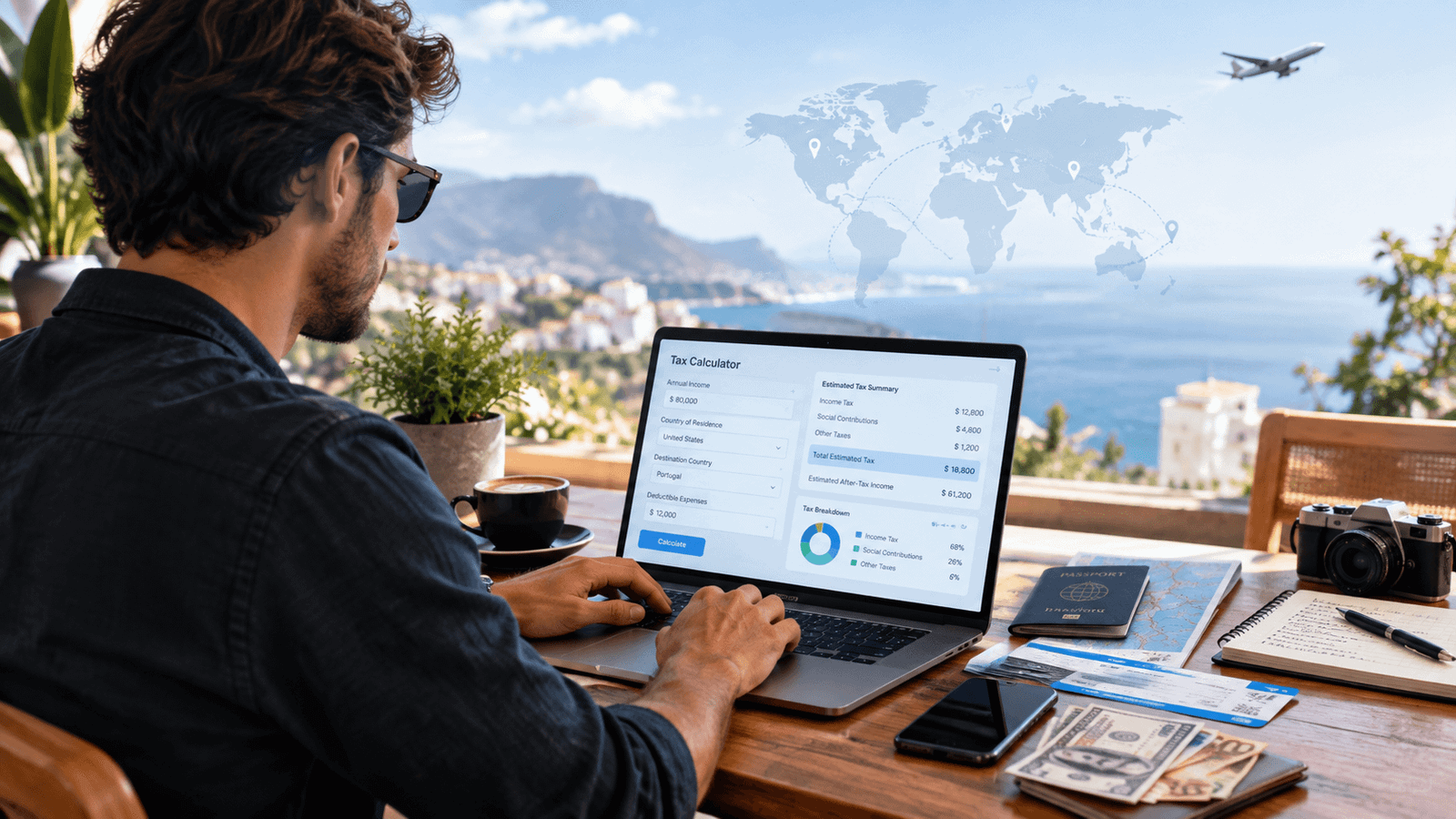
But before booking your one-way flight, there is one important question you should answer: How much tax will you actually pay after moving abroad?
A good tax calculator can help you estimate your potential income tax, social contributions, foreign taxes, deductions, and overall tax burden before you move. However, your actual tax liability depends on factors such as your current tax residency, the country you move to, how long you stay, where you perform your work, your income type, and whether a tax treaty applies.
In this guide, we’ll explain how to calculate your potential digital nomad taxes before moving abroad and what information you should collect before making your move.
Important: This article provides general educational information, not personalized tax advice. International tax rules vary by country and can change. For a real tax filing or residency decision, consult a qualified tax professional in the relevant jurisdictions.
What Is a Digital Nomad Tax Calculator?
A digital nomad tax calculator is a tool designed to help remote workers, freelancers, entrepreneurs, and location-independent professionals estimate their potential tax obligations when living and working abroad.
Instead of looking only at your salary or freelance income, a useful calculator should consider several variables, including:
- Annual or monthly income
- Country of tax residence
- Destination country
- Number of days spent in each country
- Employment or self-employment status
- Business expenses
- Tax deductions
- Social security or social insurance contributions
- Foreign taxes already paid
- Applicable tax treaties
- Potential tax credits or exclusions
For example, someone earning $80,000 while spending a few months in another country may have a very different tax situation from someone who permanently establishes tax residence there.
That is why simply searching for a country’s income tax rate is often not enough.
Why Should You Calculate Your Taxes Before Moving Abroad?
Tax problems are much easier to prevent than to fix. Before relocating, you should have a reasonable estimate of your potential tax liability so you can create a realistic budget.
A pre-move tax calculation can help you answer questions such as:
- How much of my income might go toward taxes?
- Could I become a tax resident in my destination country?
- Do I still have tax obligations in my current country?
- Could I owe taxes in more than one country?
- Will I need to pay social security contributions?
- Does a tax treaty affect my situation?
- How much money should I reserve for taxes each month?
- Would changing my residency or business structure affect my obligations?
These questions are especially important for digital nomads because working remotely can create tax considerations in more than one jurisdiction.
Step 1: Determine Your Current Tax Residency
The first step in using a digital nomad tax calculator is identifying your current tax residency.
Tax residency is not necessarily the same thing as citizenship.
A person can be a citizen of one country, live in another country, and potentially become tax resident somewhere else depending on the applicable rules.
Countries may use factors such as:
- Number of days physically present
- Permanent home
- Family and personal ties
- Economic connections
- Employment or business activities
- Local registration
- Other statutory residency tests
Do not assume that leaving your home country automatically ends your tax obligations there.
Before moving, check the tax-residency rules of both your current country and your planned destination.
Step 2: Calculate Your Total Annual Income
Next, determine how much income you expect to earn during the tax year.
For example:
Freelance income: $60,000
Online business income: $20,000
Other taxable income: $5,000
Estimated total income: $85,000
Your calculation should distinguish between different types of income where relevant.
Common income sources for digital nomads include:
- Salary
- Freelance income
- Consulting fees
- Business profits
- Affiliate income
- Royalties
- Investment income
- Rental income
- Capital gains
This distinction matters because different types of income may be treated differently under local tax rules.
For example, the IRS explains that foreign earned income generally relates to compensation for personal services performed in a foreign country, while investment income such as dividends, interest, and capital gains is treated differently.
Step 3: Estimate Your Business Expenses
If you are self-employed or operate an online business, don’t calculate tax based only on gross revenue.
You may have legitimate business expenses that affect taxable profit, depending on the rules that apply to you.
Potential expenses could include:
- Laptop and computer equipment
- Software subscriptions
- Website hosting
- Professional services
- Business insurance
- Coworking expenses
- Advertising
- Certain travel expenses
- Accounting fees
For example:
Gross business income: $100,000
Eligible business expenses: $20,000
Estimated business profit: $80,000
The exact deductions available depend on your country and tax situation, so a calculator should treat deductions as an estimate rather than automatically assuming every expense is deductible.
Step 4: Check the Destination Country’s Tax Rules
Once you know your estimated income, research the tax rules in the country where you plan to live.
Pay particular attention to:
Income tax
Find out how the country taxes employment income, self-employment income, business profits, and other relevant income.
Tax residency
Determine when someone becomes tax resident under local law.
Social contributions
Income tax is not always the only cost.
Depending on the country and your status, you may also have to consider social security, health insurance, pension contributions, or similar mandatory contributions.
Local business obligations
If you operate a business while abroad, there may be registration, reporting, or other compliance requirements.
Special digital nomad regimes
Some countries offer immigration or tax programs specifically aimed at remote workers. However, having a digital nomad visa does not automatically mean that you are exempt from local taxation.
Always check the actual tax rules associated with the program.
Step 5: Understand Where You Perform Your Work
One common mistake is assuming that the location of your client or bank account automatically determines where your income is taxed.
That is not necessarily how international taxation works.
For example, the IRS states that the source of earned income is generally determined by where the services are performed. It also notes that the location of the employer or the bank receiving payment does not by itself determine the source of compensation for these purposes.
This illustrates why digital nomads should consider where they physically perform their work, not just where their clients or bank accounts are located.
Different countries can apply different sourcing and residency rules, so your specific situation needs to be checked against local law.
Step 6: Check Whether You Could Become Tax Resident Abroad
This is one of the most important steps.
Spending an extended period in another country can potentially create tax-residency consequences.
Many people are familiar with the idea of a “183-day rule,” but this should not be treated as a universal international tax rule.
Different countries use different tests, and some can consider additional factors beyond the number of days you spend there.
Your calculator should therefore allow you to enter:
- Arrival date
- Departure date
- Total days in the country
- Previous stays
- Other countries visited
- Permanent-home information where relevant
Keeping an accurate travel calendar is particularly important for people who move between several countries during the year.
Step 7: Consider Tax Treaties and Double Taxation
What happens if two countries claim taxing rights over the same income? This is where tax treaties can become important.
Tax treaties can provide rules for allocating taxing rights and addressing certain forms of double taxation.
The OECD Model Tax Convention is an important framework used by countries when negotiating and interpreting bilateral tax treaties.
However, the existence of a tax treaty does not automatically mean you will pay tax in only one country.
The actual result depends on:
- The countries involved
- Your residency status
- Your income type
- The specific treaty
- Domestic tax law
- Any applicable tie-breaker rules
- Foreign tax credits or exemptions
For this reason, your digital nomad tax calculator should ideally treat treaty benefits as part of an estimate rather than making a blanket assumption.
Step 8: Don’t Forget Social Security and Other Contributions
Your total tax burden can be higher than your income-tax rate suggests.
Depending on your circumstances, you may have obligations such as:
- Social security
- Pension contributions
- Health insurance contributions
- Self-employment taxes
- Local levies
For example, U.S. citizens and resident aliens working abroad may still have U.S. tax and self-employment considerations even when they qualify for certain foreign-earned-income benefits. The IRS specifically notes that the foreign earned income exclusion does not automatically eliminate self-employment tax.
Therefore, when estimating your total cost of living abroad, look beyond the headline income-tax rate.
Step 9: Calculate Your Estimated Taxable Income
Once you’ve collected the relevant information, you can build a basic calculation.
A simplified example might look like this:
Annual income: $90,000
Estimated deductible expenses: $15,000
Estimated net income: $75,000
Then you might estimate:
Income tax: $12,000
Social contributions: $6,000
Other estimated taxes: $1,000
Estimated total: $19,000
Your estimated after-tax income would therefore be:
$90,000 − $15,000 − $19,000 = $56,000
This is only an illustrative calculation. Actual tax treatment can be significantly more complicated depending on the countries involved.

Digital Nomad Tax Calculator: What Information Do You Need?
Before using a calculator such as the one provided by NomadMetrics.online, prepare the following information.
| Information | Why It Matters |
|---|---|
| Annual income | Helps estimate your taxable income |
| Income type | Different income types can have different tax treatment |
| Current country | Determines potential existing obligations |
| Destination country | Helps estimate local taxation |
| Number of days abroad | Can affect residency |
| Business expenses | May reduce taxable profit where permitted |
| Employment status | Employee, freelancer, or business owner can matter |
| Foreign taxes paid | May affect credits or double-taxation calculations |
| Tax treaty | Can affect taxing rights and relief |
| Social contributions | May increase your total tax burden |
The more accurate your inputs, the more useful your estimate will be.
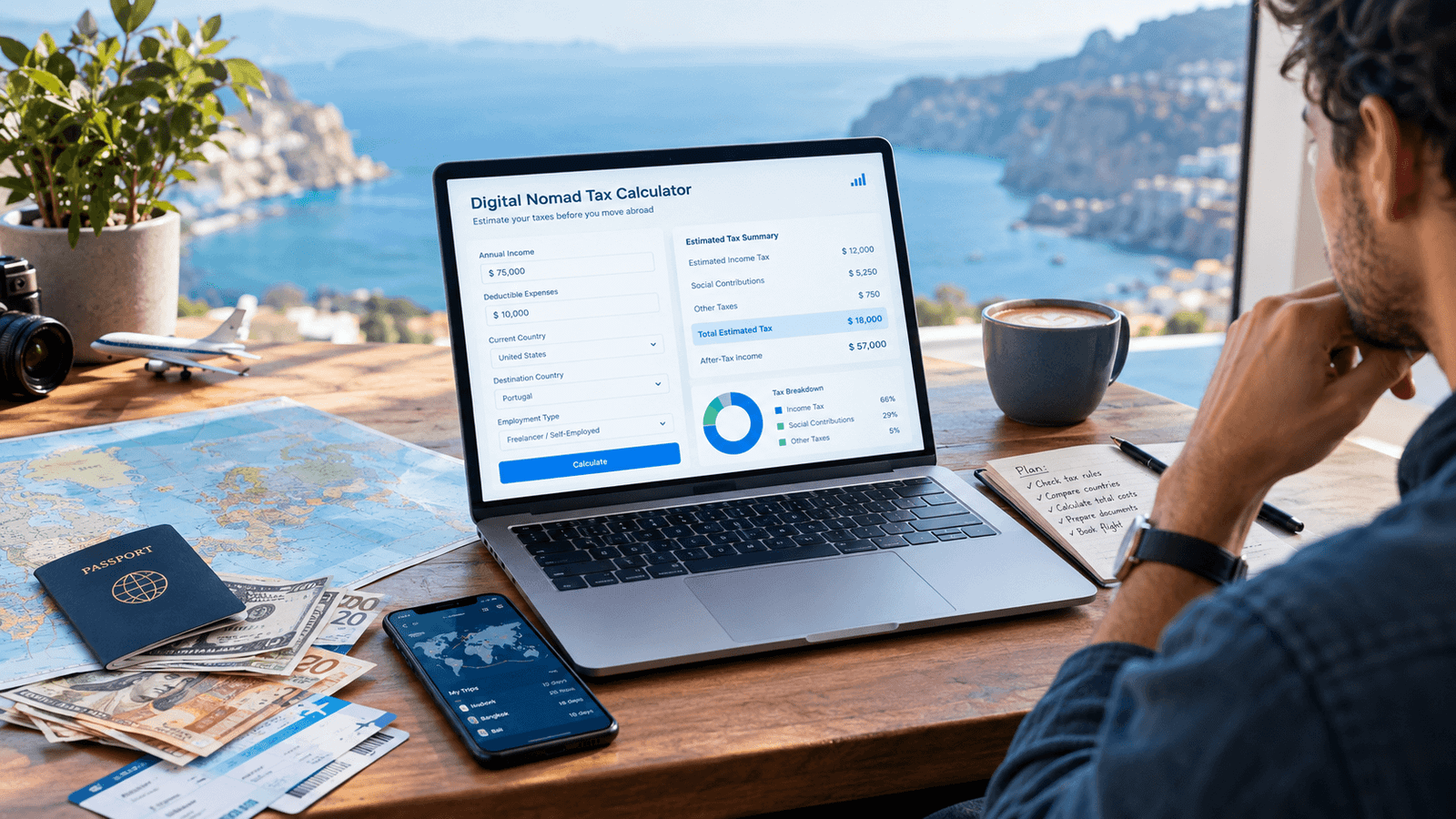
Example: Estimating Taxes Before Becoming a Digital Nomad
Imagine you are a freelancer earning $75,000 per year.
You are considering moving abroad and estimate that you will have:
- $75,000 annual revenue
- $10,000 in business expenses
- $65,000 estimated business profit
You then compare the potential tax rules applicable to your current country and your destination.
Instead of asking only:
“What is the income tax rate in my destination?”
you should ask:
“What could my total tax obligation look like after considering residency, income, deductions, social contributions, and potential foreign-tax relief?”
That’s the more useful question a digital nomad tax calculator should help you investigate.
What About U.S. Digital Nomads?
U.S. citizens and certain U.S. residents living abroad can face additional considerations because the United States generally taxes citizens and resident aliens on worldwide income.
The IRS explains that qualifying taxpayers may be able to use the Foreign Earned Income Exclusion if they meet specific requirements, including having a foreign tax home and satisfying either the bona fide residence test or physical presence test.
For the physical presence test, the IRS generally refers to being physically present in foreign countries for at least 330 full days during a 12-month period.
However, qualifying for the Foreign Earned Income Exclusion does not mean every form of income becomes tax-free, and it does not automatically eliminate every U.S. tax obligation.
This is one reason a calculator should distinguish between income tax, exclusions, credits, and self-employment taxes.
Common Digital Nomad Tax Mistakes
1. Assuming a tourist visa means no taxes
Immigration status and tax status are different concepts.
A visa may determine how long you can legally stay, while tax residency is determined under applicable tax rules.
2. Assuming 183 days always means tax residency
The 183-day concept is common, but international tax rules are not identical everywhere.
Check the actual rules for the country involved.
3. Ignoring your home country’s tax rules
Moving abroad does not necessarily terminate all tax obligations in your original country.
4. Looking only at income tax
Social contributions and other mandatory payments can materially affect your total cost.
5. Mixing business revenue with personal income
If you’re self-employed, revenue and taxable profit may not be the same thing.
6. Forgetting to track travel days
If you move between countries frequently, accurate day tracking can become essential.
7. Assuming a digital nomad visa means zero tax
A digital nomad visa is primarily an immigration framework. Tax consequences require a separate analysis.
How a Digital Nomad Tax Calculator Can Help
Doing international tax calculations manually can quickly become confusing.
A digital nomad tax calculator can make the initial planning process easier by helping you organize the major variables in one place.
With NomadMetrics.online, users can use estimated tax calculations as a starting point for questions such as:
- Where might my tax burden be higher or lower?
- How much should I reserve for taxes?
- What could my after-tax income look like?
- How might my income and expenses affect the estimate?
- What information should I take to a tax professional?
- What should I investigate before moving?
The calculator should be viewed as a planning and estimation tool, not a replacement for professional tax advice.

A Simple Pre-Move Tax Checklist
Before moving abroad, work through this checklist:
Before you leave
- Determine your current tax residency
- Check whether leaving affects your existing tax obligations
- Estimate annual income
- Separate earned and investment income
- Estimate business expenses
- Research destination-country tax rules
- Check residency requirements
- Review social contribution rules
- Research relevant tax treaties
- Track your travel days
- Estimate your total annual tax burden
- Keep documentation for income and expenses
- Speak with a qualified tax professional when necessary
Frequently Asked Questions
Start with your current tax residency, destination, expected income, income type, expenses, days spent in each country, social contributions, and potential tax-treaty rules. A digital nomad tax calculator can then provide an initial estimate.
Potentially, yes. Digital nomads can have tax obligations in one or more jurisdictions depending on residency, income source, where work is performed, and local law.
No. Moving abroad does not automatically terminate tax residency or other obligations in every country.
Not necessarily. Immigration permission and tax residency are separate issues.
It is possible for domestic laws to treat a person as resident in more than one country. Tax treaties may provide rules for resolving certain dual-residency situations.
Yes, as a planning tool. A calculator can help you understand the potential tax impact before you commit to a move, but complicated cases should be reviewed by a qualified professional.
Summery
Moving abroad as a digital nomad is about more than choosing a beautiful destination and finding reliable Wi-Fi.
Your tax situation can have a significant impact on your real cost of living and the amount of money you keep after taxes.
The key is to calculate before you move not after you receive an unexpected tax bill.
Start by identifying your tax residency, estimate your income and expenses, research the tax rules in your destination, consider social contributions and tax treaties, and keep track of the countries where you spend time.
Then use a digital nomad tax calculator to create an initial estimate and identify the questions that need deeper professional review.
Ready to estimate your potential taxes before moving abroad? Explore the Digital Nomad Tax Calculator at NomadMetrics.online and start planning your move with a clearer picture of your potential tax costs.